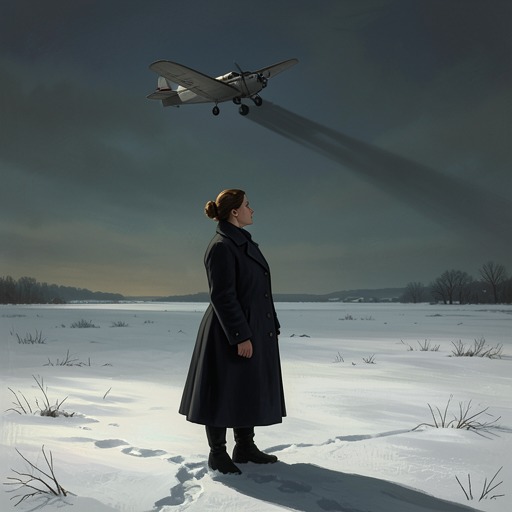
Kristín and Ratoff’s deadly confrontation after his violence against her
Operation NapoleonKristín and Ratoff’s deadly confrontation after his violence against her turns a struggle over what she knows about Napoleon into an intimate contest of coercion, grief, and survival. Ratoff uses an awl to torture Kristín and shoots Steve in front of her, making Steve’s death an act of torment directed at her; much later, she watches Ratoff approach an aircraft’s open cargo door and finds herself unable to feel the hatred that once consumed her.
Coercion and Steve’s death
On Vatnajökull Glacier, Ratoff presses Kristín for answers about Napoleon while bringing his face close and running an awl along her throat, chin, cheek, and near her eye. She has no answer that might satisfy him, but tries to say something that will delay him. His proximity makes her recognize that she is in the same terror her brother had faced: she understands what it is to be close to Ratoff and fear dying at his hands.
When Kristín says that another person is lying, Ratoff thrusts the awl through her snowsuit and clothes into her side, just below her ribs. The wound initially feels like a pinch; then pain sears through her as blood seeps inside her clothes. Ratoff holds the tool in the wound and twists it while demanding to know who else knows about Napoleon. Steve struggles in the guards’ grip as Kristín cries out. Ratoff eventually pulls the awl free, draws a revolver, and tells Kristín that she could have saved Steve, framing his coming death as something for which she should blame herself.
Without warning, Ratoff turns and fires once into Steve’s face. Kristín sees him fall onto the ice, his head striking the frozen ground, and registers the blood on the tent wall and beneath him. The shock overwhelms her: she retches, collapses, and blacks out. Her last sight is Steve’s empty eyes, while Ratoff’s voice is the last sound she hears. The killing makes their conflict personal in a way Kristín cannot explain; later, she tells Miller that Ratoff did not need to kill Steve and did so to torment her.
From vengeance to exhaustion
In the wreck of the Junkers Ju 52, Kristín tells Miller what happened, including Ratoff’s murder of Steve. She sees a point of contact in Miller’s search for his brother and trusts his willingness to listen. As she recounts the events, however, the story becomes an accusation against herself: she believes Steve died because of her impulsive, stubborn pursuit of answers. Miller believes her, but when she asks whether Ratoff is there and demands to know what is happening, he tries to protect her from learning more. Kristín refuses to let him decide for her; she has come too far to give up.
Later, aboard the aircraft, Kristín discovers Ratoff lashed to a pallet in the cargo hold, stripped to the waist and marked by blood and lacerations. The aft door is lowering into the moonlit night, and the men nearby treat him like freight rather than a person, ignoring his struggle and cries. As the pallet inches toward the opening, Kristín remembers the awl in her side, Elías pleading for mercy in Ratoff’s grasp, and Steve falling with a bullet in his face. The memories renew her loathing, drawing her from hiding toward the man who had made her suffer and killed Steve.
Ratoff begs Kristín to untie him. She follows the pallet briefly, then stops: the anger and hatred have drained away, leaving her numb. She watches it tilt and fall through the open door, with Ratoff disappearing into the darkness. The scene reverses their earlier positions of power, but offers no release. As the door closes, Kristín is close to collapse, overwhelmed by sleeplessness, horror, and guilt over Steve; she briefly considers stepping into the void herself. The impulse passes, leaving the relationship’s final balance not as triumph or forgiveness, but as exhaustion after violence.
Looking, being watched, and losing the power to feel
The conflict is repeatedly organized around looking. Ratoff watches Kristín’s response to pain with scientific detachment, treating her body as a surface from which he can extract knowledge about Napoleon. His violence moves from the awl near her eye to the wound in her side, while his questions make her visible to him as a source of information rather than a person. After he kills Steve, that same act of watching becomes part of the injury: Kristín sees the death, and Ratoff observes what it does to her.
The later encounter reverses this arrangement without restoring Kristín’s earlier sense of agency. Ratoff is now the watched figure, bound and carried toward the open cargo door as the men around him disregard his cries. Kristín’s attention first returns to the earlier scenes of violence, but when Ratoff asks for help, she finds neither the hatred that had drawn her toward him nor any impulse to answer his plea. Her emotional blankness is not reconciliation; it marks the cost of having been made witness to repeated brutality. The final contrast is between Ratoff’s former scrutiny of her reactions and her exhausted gaze at his disappearance: she sees the end of his power over her, but not as a victory capable of undoing what he has done.
The confrontation’s temporal and bodily echo
The scene is dated 0030 GMT on Sunday, 31 January, but Kristín’s sense of time fractures under Ratoff’s threat: she wonders whether the terror she is now experiencing began only the previous evening or the day before. That compressed interval links her own ordeal to her brother’s, as she recognizes that she has been placed in the same position and can now understand his fear of Ratoff and of dying. The recognition makes Ratoff’s violence more than a new danger; it forces Kristín to inhabit, bodily and immediately, the terror she had previously seen from outside. When he later begs her for help, the history between them is therefore bound not only to Steve’s murder but also to the pain she endured and the fear she now understands in relation to her brother.